| title |
|---|
C / Pointer |
C / Pointer
-
C Pointers: A Complete Beginner's Guide - Programiz
-
Pointers are powerful features of C and (C++) programming that differentiates it from other popular programming languages like Java and Python.
Pointers are used in C program to access the memory and MANIPULATE THE ADDRESS.
Address in C
-
Before you get into the concept of pointers, let's first get familiar with address in C.
If you have a variable
varin your program,&varwill give you its ADDRESS in the memory, where&is commonly called the REFERENCE OPERATOR.可以將
&取得的 address 視為 reference;反過來要取得 referece 背後的值則稱做 dereference。 -
You must have seen this notation while using
scanf()function.scanf("%d", &var);It was used in the function to store the user inputted value in the address of
var.#include <stdio.h> int main() { int var = 5; printf("Value: %d\n", var); printf("Address: %u", &var); //Notice, the ampersand(&) before var. return 0; }Output
Value: 5
Address: 2686778
Note: You may obtain different value of address while using this code.
In above source code, value 5 is stored in the memory location 2686778.
varis JUST THE NAME GIVEN TO THAT LOCATION.
Pointer variables
-
In C, you can create a special variable that STORES THE ADDRESS (rather than the value). This variable is called POINTER VARIABLE or simply a pointer.
-
How to create a pointer variable?
data_type* pointer_variable_name;
int* p;
Above statement defines,
pas pointer variable of typeint.注意 "pointer variable of type XXX" 的說法;雖然 pointer variable 裡面存的都是 address,但該 address 可以指向不同的型態。
Reference operator (&) and Dereference operator (*)
-
As discussed,
&is called reference operator. It gives you the address of a variable.Likewise, there is another operator that gets you the value from the address, it is called a DEREFERENCE OPERATOR
*.面對一般的 variable 時,透過 variable name 讀寫的是它的 value,要搭配
&才能拿到 address;面對 pointer variable 時,透過 varialbe name 讀寫也是它的 value,不過此時 value 是指向它處的 address (因 pointer variable 自己的 address 不同),要搭配*才能取到存放在它處 address 的值。#include <stdio.h> int main() { int val; int *addr; int **addr2; val = 2; addr = &val; addr2 = &addr; printf("&val = %u\n", &val); printf("val = %u\n", val); printf("&addr = %u\n", &addr); printf("addr = %u\n", addr); printf("*addr = %u\n", *addr); printf("addr2 = %u\n", addr2); printf("**addr2 = %u\n", **addr2); }輸出:
&val = 3806188364 # 在 3806188364 有個放得進 int 的空間 val = 2 # 取出 3806188364 這空間裡的值 &addr = 3806188352 # 在 3806188352 有個放得進 adderess 的空間,裡面放著 3806188364 addr = 3806188364 # 取出 3806188352 這空間裡的值 (一個 address) *addr = 2 # 取出 3806188352 --> 3806188364 這空間裡的值 addr2 = 3806188352 **addr2 = 2 # 取出 &addr2 --> 3806188352 --> 3806188364 這空間裡的值 -
Below example clearly demonstrates the use of pointers, reference operator and dereference operator.
Note: The
*sign when declaring a pointer is not a dereference operator. It is just a similar notation that creates a pointer.#include <stdio.h> int main() { int* pc, c; c = 22; printf("Address of c: %u\n", &c); printf("Value of c: %d\n\n", c); pc = &c; printf("Address of pointer pc: %u\n", pc); printf("Content of pointer pc: %d\n\n", *pc); c = 11; printf("Address of pointer pc: %u\n", pc); printf("Content of pointer pc: %d\n\n", *pc); *pc = 2; printf("Address of c: %u\n", &c); printf("Value of c: %d\n\n", c); return 0; }Output
Address of c: 2686784
Value of c: 22

Address of pointer pc: 2686784
Content of pointer pc: 22

Address of pointer pc: 2686784
Content of pointer pc: 11

Address of c: 2686784
Value of c: 2
Explanation of the program
-
int* pc, c;Here, a pointer
pcand a NORMAL VARIABLEc, both of typeint, is created.Since
pcandcare not initialized at first, pointerpcpoints to either no address or a RANDOM ADDRESS. And, variablecHAS AN ADDRESS BUT CONTAINS A RANDOM GARBAGE VALUE. -
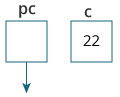
c = 22;This assigns 22 to the variable
c, i.e., 22 is stored in the memory location of variablec.Note that, when printing
&c(address ofc), we use%urather than%dsince address is usually expressed as an unsigned integer (always positive). -
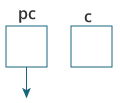
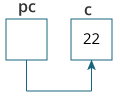
pc = &c;This assigns the address of variable
cto the pointerpc.You see the value of
pcis same as the address ofcand the content ofpcis 22 as well. -
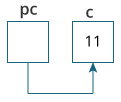
c = 11;This assigns 11 to variable
c.Since, pointer
pcpoints to the same address asc, value pointed by pointerpcis 11 as well. -
*pc = 2;This change the value at the memory location pointed by pointer
pcto 2.Since the address of the pointer
pcis same as the address ofc, value ofcis also changed to 2.
-
Common mistakes when working with pointers
-
Suppose, you want pointer
pcto point to the address ofc. Then,int c, *pc; // 等同於 int* pc, c 的寫法 (1) // Wrong! pc is address whereas, // c is not an address. pc = c; // Wrong! *pc is the value pointed by address whereas, // &c is an address. *pc = &c; // (2) // Correct! pc is an address and, // &c is also an address. pc = &c; // (2) // Correct! *pc is the value pointed by address and, // c is also a value (not address). *pc = c; // (2)-
雖然上面語法的定義是
data_type* pointer_variable_name;,但從int c, *pc的用法看來,星號往 variable name 靠 (data_type *pointer_variable_name) 的寫法比較對,否則int* pc, c很容易被解讀成pc跟c都是 pointer variable,但事實上是int *pc, c,只有pc才是 pointer。 -
也就是 assignment 的兩側要一致 -- value 或 address,其中 value 可以是 normal variable 或是 pointer variable + dereference (
*),而 address 可以是 pointer variable 或 normal variable + reference (&)
-
-
-
Pointers in C and C++ | Set 1 (Introduction, Arithmetic and Array) - GeeksforGeeks #ril
-
Pointers in C #ril
- NULL pointer in C - GeeksforGeeks #ril
- c - What is the difference between NULL, '\0' and 0 - Stack Overflow #ril
- NULL - cppreference.com 其實是個 macro? #ril
- C - Null pointer - Wikipedia #ril
- The Difference Between NULL and Zero | C For Dummies Blog (2013-07-27) #ril
- In C, why is NULL and 0 triggering an if statement - Software Engineering Stack Exchange #ril