06. IoT Protocols
An IoT protocol is a set of rules that define how Internet of Things (IoT) devices communicate with each other and with other systems. IoT protocols determine how information is formatted, transmitted, and received. The following are all the protocols supported by CatSniffer.

Sub-Ghz
Sub-GHz is a term used to describe radio frequencies below 1 GHz. This frequency band is often used for wireless communication applications because it offers several advantages over higher frequency bands, such as:
- Longer range: Sub-GHz radio waves can travel longer distances than higher frequency radio waves, making them ideal for applications where long-range communication is required.
- Better penetration: Sub-GHz radio waves can penetrate walls and other obstacles more easily than higher frequency radio waves, making them ideal for applications where communication is required in challenging environments.
- Lower power consumption: Sub-GHz radio waves consume less power than higher frequency radio waves, making them ideal for battery-powered devices.
- License-free

LoRaWAN
Learn more about LoRa/LoRaWAN in What is LoRaWAN Specifications and Semtech LoRa.
For CatSniffer the frequency tested is US915MHz.
Bluetooth Low Energy
BLE Specs:
- Low power requirements.
- BLE has a maximum range of about 100 meters.
- High data rate: BLE can transfer data at speeds of up to 3 Mb/s.
- 128-bit AES (Advanced Encryption Standard) in CCM mode and application layer user defined.
- Interoperable devices.
Learn more about Bluetooth Low Energy in Bluetooth Wireless Technology
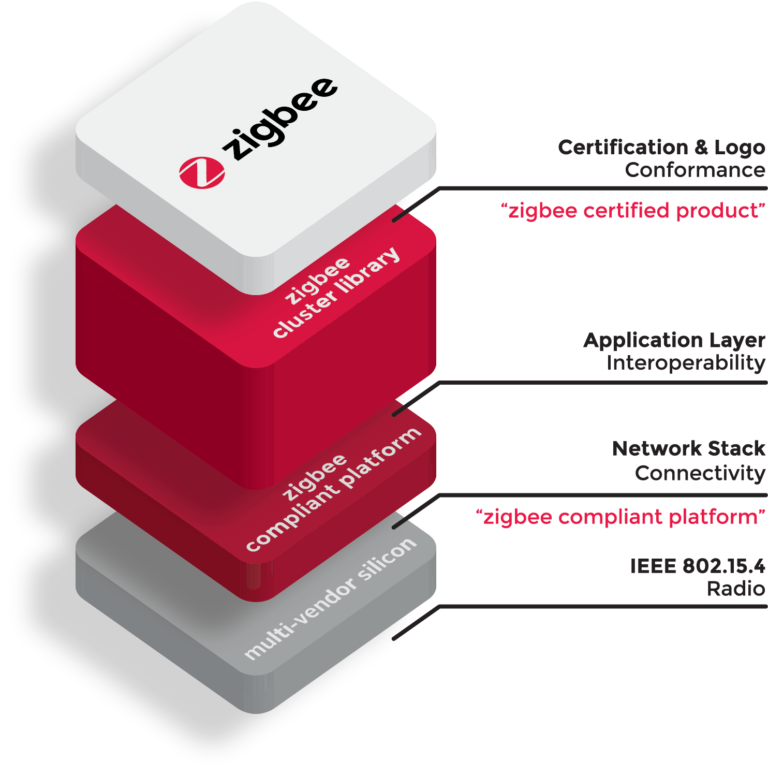
Zigbee Stack
Zigbee is based on the IEEE 802.15.4 standard and operates in the industrial, scientific and medical (ISM) radio bands, including 2.4 GHz in most jurisdictions worldwide.
Learn more about Zigbee on csa-Zigbee.

Thread
The Internet runs on IP. From phones, to routers, to connections across the globe, IP is how devices communicate directly with each other, regardless of what connectivity technologies they use (i.e. Ethernet, Wi-Fi, 5G and LTE). Thread brings the Internet to the Internet of Things by using the Internet’s proven, open standards to create an Internet Protocol version 6 (IPv6) based mesh network.
Learn more about Thread on Thread Benefits.

mioty
The core invention behind the mioty technology is the Telegram Splitting Multiple Access (TSMA) method. As defined by the European Telecommunications Standards Institute (ETSI TS 103 357), Telegram Splitting splits the data packets to be transported in the data stream into small sub-packets at the sensor level.
Learn more about it on mioty technology.

Wi SUN
Wi-SUN is based on the IEEE 802.15.4g and IEEE 802.15.4e standards, and it provides a number of features that make it well-suited for Smart City and Smart Utility applications, including:
- Long range: Wi-SUN devices can communicate over long distances, up to several kilometers in ideal conditions.
- Mesh networking: Wi-SUN networks are self-organizing and self-healing, which makes them reliable and robust.
- Low power consumption: Wi-SUN devices are designed to be low-power, which makes them ideal for battery-powered devices.
- Security: Wi-SUN networks are secure and use a variety of security mechanisms to protect data.
Learn more about Wi-SUN on its official site.
Amazon sidewalk
-
Low-bandwidth, low-power connectivity
-
Shared network: Amazon Sidewalk uses a shared network of participating Amazon devices to extend the range of your devices. This means that your devices can connect to each other even if they are not in range of your home Wi-Fi network.
-
End-to-end encryption
-
Opt-in: You can choose to opt in to Amazon Sidewalk. This means that you can decide whether or not you want your device to participate in the network.
-
Available in select countries: Amazon Sidewalk is currently available in the United States, the United Kingdom, Germany, France, Italy, Spain, and Japan.
Learn more about AmazoSidewalk on Welcome to Amazon Sidewalk.

6LoWPAN
6LoWPAN stands for IPv6 over Low-Power Wireless Personal Area Networks. It is a protocol that allows IPv6 packets to be transmitted over low-power wireless networks. 6LoWPAN is based on the IEEE 802.15.4 standard, which is a low-power wireless networking standard that is used in a variety of applications, such as smart homes and industrial automation.
6LoWPAN is designed to be used with low-power devices, such as sensors and actuators.
IEEE 802.15.4g is a standard for low-power, wireless mesh networks that operate in the sub-GHz frequency band. It is based on the IEEE 802.15.4 standard, but it provides a number of enhancements, including:
- Longer range: IEEE 802.15.4g devices can communicate over longer distances than IEEE 802.15.4 devices, up to several kilometers in ideal conditions.
- Better penetration: IEEE 802.15.4g radio waves can penetrate walls and other obstacles more easily than IEEE 802.15.4 radio waves, making them ideal for applications where communication is required in challenging environments.
- Lower power consumption: IEEE 802.15.4g devices consume less power than IEEE 802.15.4 devices, making them ideal for battery-powered devices.
Learn more about IEEE 802.15.4g on IEEE SA - IEEE 802.15.4g

- What is CatSniffer?
- Firmware
- Supported Software
- Hands‐On
- Development Reference
- Useful Links
- IoT protocols
- Restore CC1352
- FAQs
- Legacy Documentation (CatSniffer v1.x and v2.x)