A control system for achieving stable vertical hovering in fixed-wing drones using PID controllers and motion capture feedback.
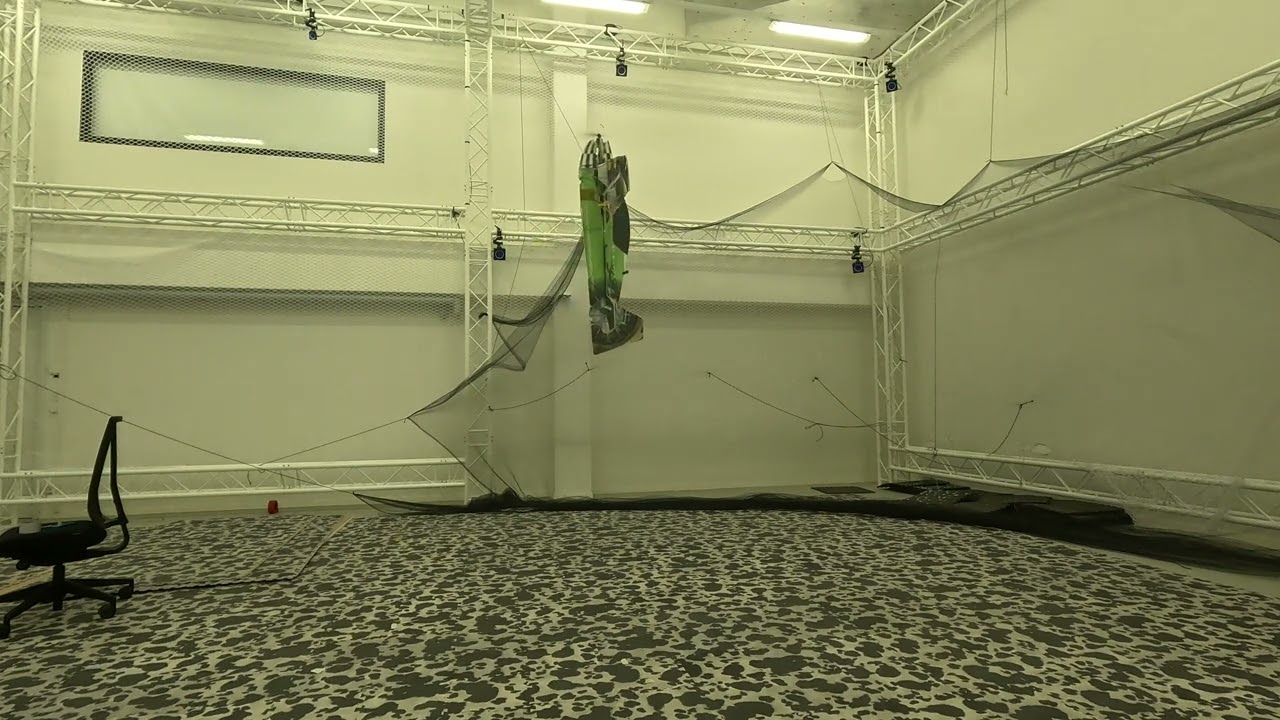
Click the image above to watch the vertical hovering demonstration
This project develops control strategies for fixed-wing UAVs to achieve stable vertical hovering, focusing on attitude control and position stabilization. Two platforms were used: Flatty (conventional front-propeller) for validation and Perchug (rear-propeller pusher configuration).
The system uses 6 PID controllers for complete hovering control:
- Roll Control: Maintains constant roll using aileron deflection
- Altitude Control: Z-position control via throttle command
- Pitch Control: Cascaded PID (outer: x-position, inner: pitch angle)
- Yaw Control: Cascaded PID (outer: y-position, inner: yaw angle)
Reference → PID Controller → Actuator → Drone → Sensor → Feedback

- Platform: T-Motor AM20 F3P-A (Flatty) / Custom Perchug
- Controller: Arduino Nano IOT 33 with WiFi
- Position Feedback: OptiTrack Motion Capture System
- Actuators: Servo-controlled elevator, rudder, aileron
- Propulsion: Brushless motor with 30A ESC
| Aspect | Flatty (Front Propeller) | Perchug (Rear Propeller) |
|---|---|---|
| Stability | Inherently stable (pendulum) | Inherently unstable (inverted pendulum) |
| Thrust Vector | Pulls from above | Pushes from below |
| Roll Control | Full aileron effectiveness | Limited due to reduced airflow |
| Equilibrium | Zero elevator deflection | Requires elevator offset for COG compensation |
- COG Offset: Thrust vector doesn't pass through center of gravity
- Elevator Compensation: Requires constant offset to counter pitching moment
- Inverted Pendulum: Unstable configuration requiring precise control
- Limited Roll Authority: Reduced airflow over wings affects roll control
- Successfully achieved stable hovering
- Full position and attitude control demonstrated
- Validated PID control methodology
- Pitch and yaw control successfully tuned
- Altitude control functional with spinning motion
- Roll control limited but system remains controllable
- Pitch Control: Hang drone from wings, tune with ±10° square wave
- Yaw Control: Similar hanging setup, independent tuning
- Altitude Control: Tune throttle-to-altitude response
- Roll Control: Tune while hovering with slack cables
- Position Control: Final tuning of x,y position loops
- Thrust Range: ±1% variation around hovering thrust
- Control Frequency: Real-time motion capture feedback
- Elevator Offset: -8° pitch, 4° yaw equilibrium (Perchug)
- Assumptions: Decoupled control, small angular rates, low-speed flight
- Roll Enhancement: Wing-mounted motors for differential thrust
- Autonomous Operation: Remove motion capture dependency
- Gain Scheduling: Adaptive control for varying flight conditions
- Prop-Hanging: Traditional fixed-wing hovering technique
- VTOL Operations: Vertical takeoff and landing capabilities
- Research Platform: Control algorithm development and validation