
From problem description to runnable evolutionary algorithm search — in one command.
LLM-driven automated algorithm design with evolutionary optimization
Quickstart · Docs · Wiki · Online Demo




- 🔬 [2026.07][New Feature]: Search methods migrated — EoH, MEoH, ReEvo, and MCTS-AHD are now available as standalone orchestrators. See Search Methods.
- 🧠 [2026.07][New Feature]: MindMemOS-backed long-term memory is now available, with global, project, and task memory scopes plus configurable Chat and Embedding model bindings. See the Memory Guide.
- 🚀 [2026.07][New Release]: LLM4AD_Next Online Trial is now available at https://llm4ad-next.cn/ — try the full problem-to-algorithm workflow directly in your browser with no local setup.
- ✨ [2026.07][New Feature]: Introducing an interactive problem-to-project workflow that turns natural-language problem descriptions into runnable evolutionary algorithm search projects.
- 🐳 [2026.07][New Feature]: Versioned Docker Hub deployment images are now aligned with GitHub Release tags for reproducible local deployment.
Traditionally, using Large Language Models for Automated Algorithm Design (LLM4AD) required a tedious, multi-step configuration pipeline. LLM4AD_Next destroys this entry barrier.

With LLM4AD_Next, after creating your directory, all of these painful steps are fully automated through an interactive conversational terminal. Just run:
uv run llm4ad chatOur built-in AI-powered consultant will interview you, instantly understand your requirements, and automatically generate a ready-to-run pipeline (evaluator, algorithm skeleton, configuration, and debugger) so you can leap straight into producing Useful Algorithms.
- 🧠 LLM-Powered Design & 🧬 Evolutionary Optimization combined to automatically evolve top-performing code.
- 💬 Interactive Configuration (
llm4ad chat) — Your conversational AI consultant that generates the entire runnable app framework. - 🔍 Evolve-Block Advisor & Recommender — Point LLM4AD_Next at any repository, and it will scan, score, and recommend exactly which blocks of code are most promising to evolve to hit your goals.
Migration status of the Automatic Heuristic Design (AHD) search methods from the original LLM4AD platform.
| Method | Status | Method | Status |
|---|---|---|---|
| IslandGA | ✅ Available | FunSearch | ⏳ Pending |
| MEoH | ✅ Available | HillClimb | ⏳ Pending |
| DyCA | ✅ Available | LHNS | ⏳ Pending |
| EoH | ✅ Available | LLaMEA | ⏳ Pending |
| ReEvo | ✅ Available | MLES | ⏳ Pending |
| MCTS-AHD | ✅ Available | MOEA/D | ⏳ Pending |
| NSGA-II | ⏳ Pending | ||
| PartEvo | ⏳ Pending | ||
| RandSample | ⏳ Pending |
Set evolution.type in your config and run llm4ad run <config.yaml>. See examples/config/config.complete.yaml for full examples.
evolution:
type: "eoh" # options: "eoh", "meoh", "reevo", "mcts_ahd", "island_ga", "dyca"|
Try Online |
Watch Instruction |
Read Docs |
| Run LLM4AD_Next in your browser. No installation or API key required. | Watch the introduction before installing or configuring a local environment. | Use the documentation path map for setup, configuration, examples, and Web UI deployment. |

|

|

|
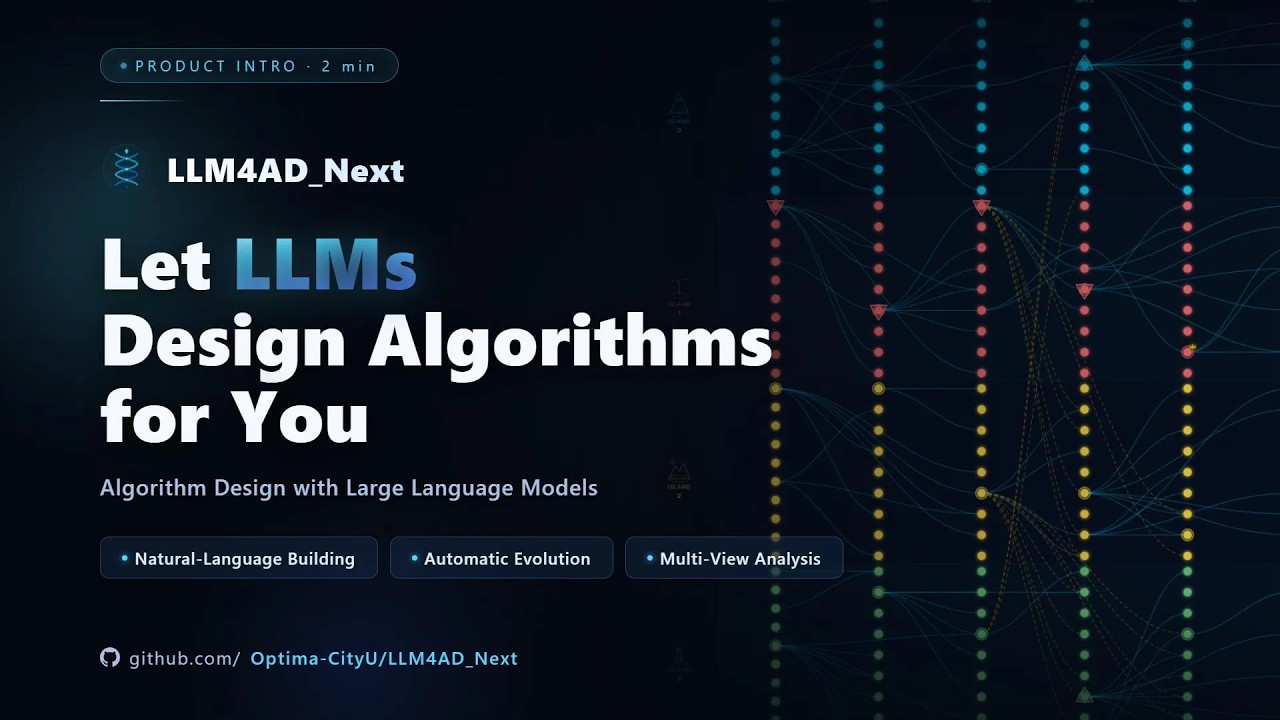
Use the online demo from Quick Start, or open it directly: Launch Online Demo.
No setup, no API key needed — just open the link and start designing algorithms.
Requires Python 3.12+ (pinned in .python-version) and uv (recommended) or pip. A plain uv sync sets up everything, including the chatv2 AI build agent, out of the box.
# Clone the repository
git clone https://github.com/Optima-CityU/LLM4AD_Next.git
cd LLM4AD_Next

# Install dependencies
uv sync

# Configure your LLM provider (see Global Settings section below)
# Or set environment variables directly:
export LLM_BASE_URL="https://api.openai.com/v1"
export LLM_API_KEY="your-api-key"
export LLM_MODEL="gpt-4o"

# Option 1: Interactive configuration (recommended for new users)
llm4ad chat

# Option 2: Run with an existing config file
llm4ad run examples/applications/tsp_benchmark_python/config.yaml
For optional dependency groups (infra, providers, eval, dev, docs, all) and uv installation, see the Installation Guide.
Create ~/.llm4ad/settings.yaml to configure shared providers across all projects:
providers:
  - name: default
    type: openai
    api_key: ${OPENAI_API_KEY}
    model: gpt-4o
  - name: anthropic
    type: anthropic
    api_key: ${ANTHROPIC_API_KEY}
    model: claude-sonnet-4-20250514
Task configs then only need the provider name — credentials and model are resolved from global settings automatically.
For CLI commands, the interactive chat workflow, the Evolve-Block Advisor / Recommender, and the Python API, see the Documentation.
# Serve documentation with live reload
mkdocs serve

# Build static documentation
mkdocs buildLLM4AD/
├── src/llm4ad/ # Main source code
│ ├── config/ # Configuration schemas and global settings
│ ├── consultant/ # Interactive configuration wizard
│ ├── builder/ # Task builder (analyzer, creator, validator, writer)
│ ├── advisor/ # Evolve-block advisor and recommender
│ ├── provider/ # LLM provider implementations
│ ├── planner/ # Algorithm planning layer
│ ├── coder/ # Code generation layer
│ ├── evaluator/ # Evaluation layer
│ ├── orchestrator/ # Workflow orchestration
│ ├── infra/ # Infrastructure (Ray, monitoring)
│ └── utils/ # Utilities
├── examples/ # Example configurations and applications
├── tests/ # Test suite
└── docs/ # Documentation
Contributions are welcome! Please read our Contributing Guide for details.
# Set up development environment
uv sync --extra all

# Run tests
pytest

# Format code
black src/ tests/
ruff check src/ tests/ --fixThis project is licensed under the BSD 3-Clause License - see the LICENSE file for details.
Scan the QR code with WeChat to join the LLM4AD_Next community group.
