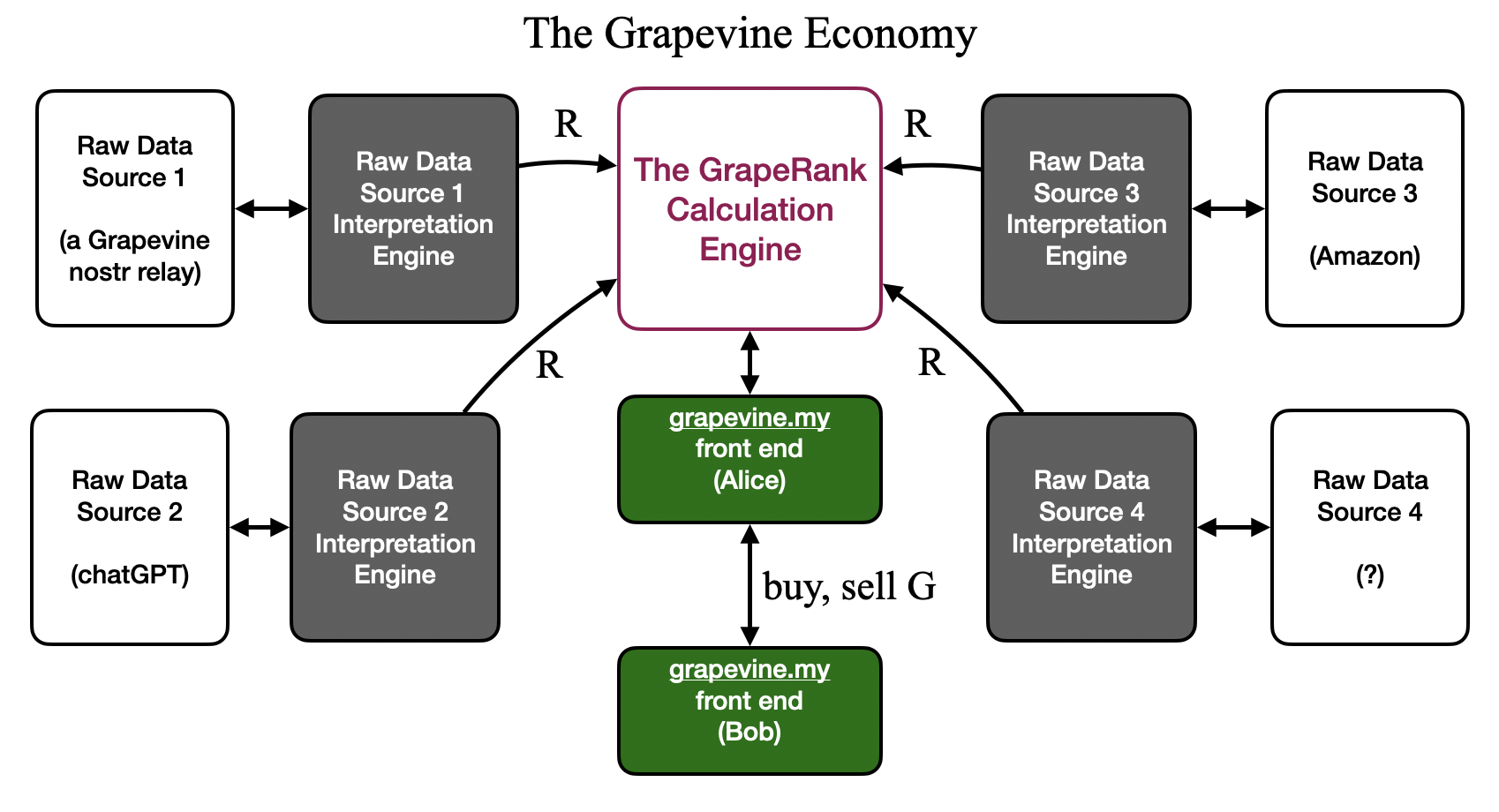
The Grapevine is divided into 5 categories of modules and 4 categories of APIs. (See the Figure below.)
Categories of Modules:
- Raw Data Source (e.g., a nostr relay)
- Interpretation Engine: this is where GrapeRank-formatted Ratings are created (maybe a DVM)
- Calculation Engine: runs the GrapeRank Equation and serves as the back end to the user interface
- the Grapevine front end
- the Grapevine Relay: stores Grapevine-specific data, including G (and R) tables in the form of NIP-51 lists. These come in two flavors:
- the Personalized Grapevine WoT Relay
- GRaasS: the Grapevine Relay as a Service
Categories of APIs:
- interface between Raw Data and Interpretation Engine
- the Calculation / Interpretation API: interface between the Interpretation Engine and the Calculation Engine
- the Endpoint API: interface between the Calculation Engine and the front end
- the Client API: interface between the Calculation Engine and the third party nostr client, e.g. Coracle

This is completely external to the Grapevine.
Examples: nostr relays (our focus of course), google, AI (Grok, ChatGPT), any legacy tech source of ratings: Amazon, Yelp, etc.
- QUESTION: Can the raw data source be ANY nostr relay? Or does it need to be a specialized relay?
- ANSWER: Any relay should work, but some relays may specialize in Grapevine services. What this means, exactly, is yet to be determined. It might mean (for example) efficient lookup of common Interpretation Engine queries, e.g. all follows and followers. It could mean full-blown pairing of the relay with the Interpretation Engine. Somewhere in-between: changes to the nostr filter API?
A specialized service which sits between raw data and the Calculation Engine. It talks to the outside world, fetches data, turns it into a list R of GrapeRank-formatted ratings r, and passes R onto the Calculation Engine.
The Interpretation Engine may operate as a DVM.
This receives GrapeRank-formatted Ratings from Interpretation Engines and runs the GrapeRank equation to produce GrapeRank Scorecards. It stores Ratings, Scorecards, and individual user settings (several categories of parameters).
Where the user goes to explore all available ScoreCards and GrapeRankRatings
There are three categories of APIs:
- interface between Raw Data and Interpretation Engine
- interface between the Interpretation Engine and the Calculation Engine
- interface between the Calculation Engine and the front end
The structure of this API will of course be entirely dependent on the type of data source.
If the data source type = nostr:
- Interpretation Engine receives a request that consists of protocolType (string) and parameters (JSON)
- The Interpretation Engine builds a standard nostr filter and uses it to query one or more relays (relays may or may not be specified within the parameters)
- The Interpretation Engine receives a stream of events from the relay
- The Interpretation Engine runs a function that inputs raw events, protocolName, and parameters and outputs a GrapeRank-formatted Ratings Table (R)
- Interpretation Engine receives a request from the Calculation Engine which must contain:
- protocolType (string)
- parameters (JSON [? stringified]), the structure of which is dependent upon the
- Intepretation Engine interacts with the Raw Data Source.
- Interpretation Engine returns data to the Calculation Engine
- GrapeRank-formatted Ratings Table (R)
Each protocolType will have its own set of parameters. The "observer" may or may not be a required parameter, depending on the protocol.
The Interpretation Engine may also handle the following query:
- a request to provide a list of all supported protocolTypes (and the schema of the requisite protocol for each protocolType)
The user can:
- view the user's canonical Grapevine Network
- view and update all parameters
- create, view, and update Worldviews
- update services at the subscription page
- calculate or update GrapeRank Ratings Tables (R); this will generally initiate an interaction with an Interpretation Engine
- calculate or update GrapeRank Scorecard Tables (G)
- buy or sell Scorecards, either individually or as a list, from other users
(list may be incomplete)
Although we are nostr-focused, the Grapevine is designed to accept input from multiple sources and from multiple source types. One day, grapevine will grow beyond nostr. (See Figure.)