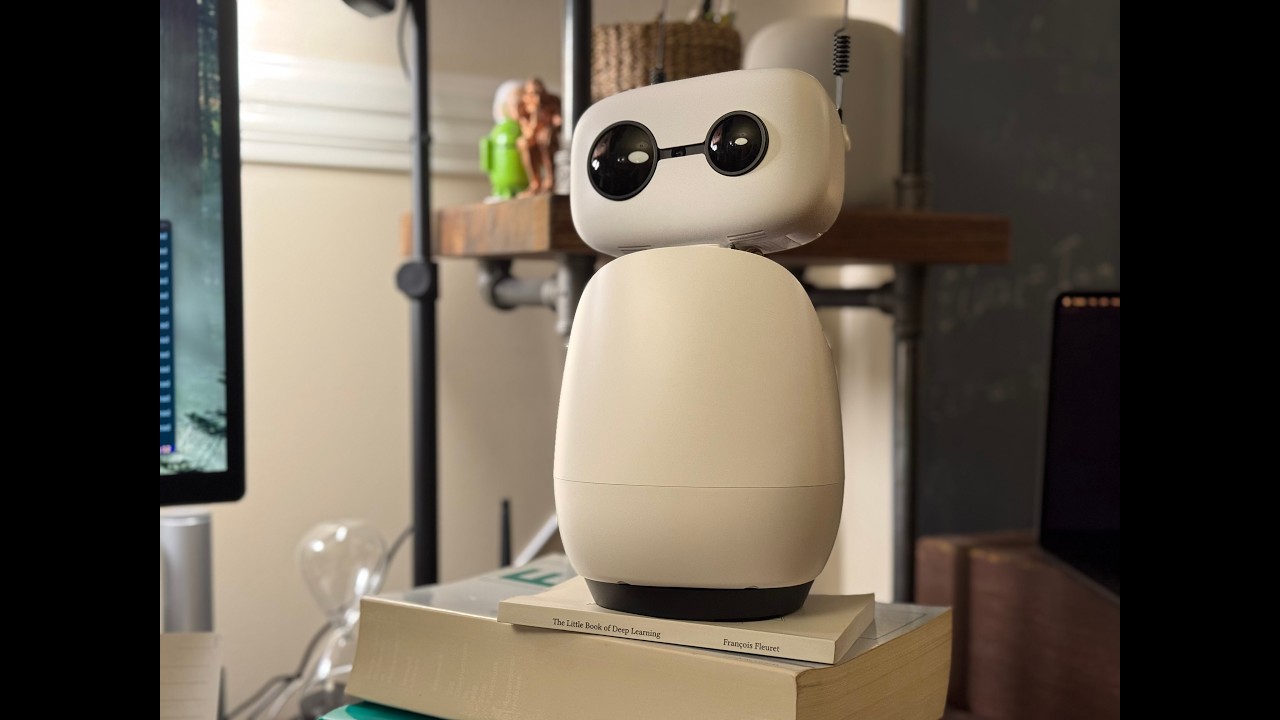
Sparky is a living and useful agent, inhabiting a Reachy Mini Lite body, orchestrated by OpenClaw for personality, skills, and multi-host span.
To see Sparky in action, check out his Hello Sparky video, or read my blog articles.
Sparky is powered by NVIDIA hardware and AI models. Through an API endpoint, Sparky can use Nemotron-Super-49B-v1.5 LLM for reasoning, language and tool-calling. Locally, Sparky uses an NVIDIA RTX 3090 to run speech-to-text (STT) with Nemotron Parakeet, text-to-speech with Kokoro (or MagPie TTS), voice recognition with GE2E VoiceEncoder, as well as SCRFD face detection, and wake-word detection.
Sparky has been designed to be useful and alive.
To be alive, Sparky starts with expressive gestures and sounds from the Reachy Mini app codebase, but adds various elements:
-
Intelligent conversation. Backed by frontier-strength text AI, to support richer discussion informed by world knowledge
-
Nuanced personality. Designed by prompts informed by theater character-construction methods, and implemented via OpenClaw's agent personality injection and memory systems (also cf. "Genuine People Personalities, by Sirius Cybernetics Corp.)
-
Independent interests. Does not just respond, but initiates conversation on an organically evolving mix of favorite topics, which evolves slowly over time in response to experience.
-
Independent actions. Spontaneous gestures, non-uniformly randomized at a human timescale, for organic surprise.
-
Social awareness. Sparky knows the identity, interests, and preferences of other household members, and recognizes them via voice recognition.
-
Relevance Detection. Sparky is designed to be always-on, like a living being, to have awareness of conversation in his environment, but to respond to conversation only when he is addressed and relevant, like a real being.
To be useful, Sparky relies on OpenClaw and various tools/skills to provide close integration with productivity and knowledge workflows, relying on the following elements:
-
Strong AI. Backed by a frontier-class AI, Sparky has strong capabilities to help with coding, writing, and other kinds of knowledge work. (Despite his unassuming form factor, Sparky is not prompted to handicap his underlying capabilities.)
-
Personal productivity data. Access to calendar and email, so Sparky can help the user with queries about communication and events, and understand the context himself.
-
Shared workspace. Sparky can see the user's mac's screen, and can see and manipulate the user's tmux windows and text editing buffers. So the user can easily direct Sparky to pay attention to what they are working on, and can ask Sparky to show the user material which Sparky has been focusing on.
-
Multi-channel, multi-host. Via OpenClaw orchestration, Sparky gets a multi-node gateway architecture which can allow Sparky directly to access multiple macs or other hosts. Also, Sparky inherits multiple other communication channels (webchat, mobile messaging, telephony).
-
Tool/skill ecosystem. Also via OpenClaw, Sparky gets a burgeoning ecosystem of typesafe tools and markdown-based skills.
-
Real-time voice interaction: wake flow, voice-activity detection (VAD) capture, local STT, streamed responses, local TTS
-
Physical embodiment: head orientation, gentle action primitives, spontaneous gestures/speech, barge-in behavior
-
OpenClaw-native orchestration: agent memory, tool use, multi-host workflows, and node command integration
-
Robot node capabilities exposed to OpenClaw: camera snapshots and physical action execution
- End-to-end OpenClaw speech loop integrated into a robot runtime
- Reliable OpenClaw node registration path with persistent node identity
- Tool-call bridge for body actions (
stretch,nod,shake,look_around,antenna_wiggle, etc.) - Local GPU-oriented inference stack for key perception tasks (Parakeet STT, SCRFD face tracking)
- NVIDIA Nemotron-Super-49B-v1.5 AI for brains, configured as an OpenClaw AI provider
- Running locally on NVIDIA RTX 3090:
- NeMo Parakeet, for fast local STT
- Kokoro TTS, for fast local TTS
- Local SCRFD face tracking on GPU
- Installation and runtime steps:
INSTALL.md - OpenClaw-specific setup:
openclaw_configs/README_openclaw.md - Architecture notes:
ARCHITECTURE.md - Speaker enrollment guide (optional voice ID):
docs/SPEAKER_ENROLLMENT.md
- Follow
INSTALL.md. - Start Reachy daemon.
- Run
python -u main.py.