
A program that emulates a MIPS CPU reading binary instructions and performing load-word and store-word operations into an L1 cache and main memory module.
The cache used is a two-way set-associative utilizing least recently used write back policy.
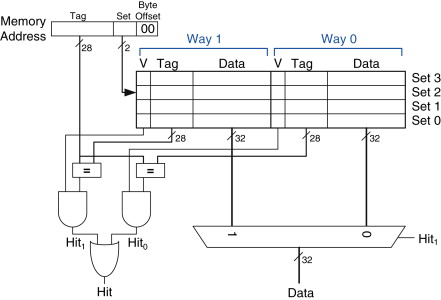
To build this program I broke each major part down and made a class for each. By doing so the code is much more organized and will be easier to read in the future. It also allows for the scoping of methods, making it clear which methods are acting on which objects.
The file structure of the program is as follows:
root/
    L>include/
        Block.hpp
        Cache.hpp
        Instruction.hpp
        Memory.hpp
        RegFile.hpp
    L>src/
        Cache.cpp
        Instruction.cpp
        main.cpp
        RegFile.cpp
    L>resources/
        L>objectCode.txt
The root folder contains 3 folders; include, resources, and src. The include folder contains header files for each of the objects used in the project, with the methods for these header files defined in the src folder. The resources folder contains the objectCode.txt file, the location where all of the instructions will be fetched from. Looking at these header files we can see the component parts of the objects.
A Block object was created allowing for easy creation of multiple blocks to make up a cache. In the Cache header we can see the declaration of a 2d array of blocks of size 8x2. This is created a cache with 8 sets with 2 blocks per set (creating a 2-way set-associative cache). The Cache object also contains methods to manipulate the history of a block, set a block as valid, or get the victim block for read miss cases.
An Instruction object was also created so that the input file could be read all at once. This object contains variables to store the binary instruction, opcode, base register, offset, raget register, byte address, and word address of an instruction. It also stores whether or not an instruction lead to a hit or a miss. Methods were also included which allowed for converting binary to an integer, decoding insturctions, printing contents of the object, printing the binary instruction, and printing the cache result (read/write hit/miss).
A Memory object was created to allow it to be clear whenever any memory accesses occured. This object contains a single array that is of size 128, representing memory that is 128 words in size.
The RegFile object contains an array of size 8, representing each of the 8 registers that are going to be used throughout the emulation. It also contains a zero constant representing the zero register. Two methods are also defined which are getReg and setReg. Get reg returns the contents of a register from its rt representation. In this case the registers can be found in the reg array at index i - 16, where i is the rt integer representation of the number. Conversely, setReg sets a given register based on its rt integer representation a a value to be stored.
The program starts by instantiating 3 objects, the RegisterFile, CacheMemory, and MainMemory. These are the 3 component parts that make up the program. We then initiazlie all the variables in these objects to avoid any segment faults when displaying the registers later in the program. An Instruction array is created to contain the 24 instructions in the objectCode.txt.
We then create an ifstream allowing for the input of data from the objectCode.txt file. Each instruction is decoded into an instruction in the myInstruction array one by one, in order. The ifstream is then closed. For each instruction in the instruction array, the following algorithm is ran.
The set and tag fields are calculated and a blockNum to track the blockNum we are using.
The cache is then checked for a hit or miss. The result is updated in the corresponding element of the instruction array
The opcode of the instruction is checked to determine which operation to perform (LW or SW)
if LW is performed
    if the instruction was a hit then we perform a read hit
    if the instruction was a miss then we perform a read miss
else if SW is performed
    if the instruction was a hit then we perform a write hit
    if the instruction was a miss then we perform a write miss
After the algorithm is ran for each instruction the resulting contents of each components are displayed. Since the values are stored as integers we use an integer to binary converter called bitPrint to show the contents as binary. Given an integer and a number of bits the instruction displays the integer in binary bit extended to match the number of bits specified.
Input: 32-bit instructions are received from the objectCode.txt file in resources/
Output: The contents of the Instructions, Registers, Cache, and Main Memory after the execution of all of the instructions are displayed.
This program was built for C++17 using the G++ compiler and GDB for debugging on Pop!OS 20.10 (Ubuntu). The code can be compiled using the following configuration.
CXX       := g++
CXX_FLAGS := -Wall -Wextra -std=c++17 -ggdb
BIN     := bin
SRC     := src
INCLUDE := include
LIB     := lib
LIBRARIES   :=
EXECUTABLE  := main
src/ must contain all .cpp files, include/ must contain all .hpp files, and resources/ must contain objectCode.txt