
This directory contains the Disruption Runaway Electron Analysis Model (DREAM) code. The online documentation is available at https://ft.nephy.chalmers.se/dream.
DREAM is a physics simulation framework developed for studying relativistic runaway electrons in tokamak fusion devices. Specifically, DREAM solves a system of non-linear partial differential equations which describe the time evolution of a tokamak plasma. What sets DREAM apart from other tokamak transport codes is its wide range of models for studying runaway electron generation and dynamics. In particular, the fluid equations solved by DREAM can be coupled to a set of kinetic equations for electrons in order to more accurately describe the runaway electrons.
The official DREAM paper is doi:10.1016/j.cpc.2021.108098 (it is also on arXiv: 2103.16457).
To compile DREAM, you need to have the following software installed:
- CMake >= 3.12
- A C++17 compatible compiler (such as gcc >= 7.0)
- GNU Scientific Library >= 2.4
- HDF5
- PETSc
- Python 3 (required for generating ADAS data and using the Python interface)
Additionally, to use the DREAM Python interface, you need the following Python packages:
- h5py
- matplotlib
- numpy
- packaging
- scipy
While most of the software required by DREAM can be installed directly from your Linux distribution's package repository, PETSc usually requires a manual setup. To install PETSc, grab its sources from the PETSc website or clone the PETSc git repository:
$ git clone -b release https://gitlab.com/petsc/petsc.git petscAfter this, compiling PETSc should be a matter of running the following commands:
$ ./configure PETSC_ARCH=linux-c-opt --with-mpi=0
...
$ make PETSC_DIR=/path/to/petsc PETSC_ARCH=linux-c-opt all
...
Optionally, you can also run make check after make all.
Once PETSc has been compiled with the above commands, you only need to make sure
that DREAM will be able to find your PETSc installation. The easiest way to
achieve this is to add the PETSC_DIR and PETSC_ARCH environment
variables used above to your ~/.bashrc file (if you use bash; if you're
unsure, you probably do):
...
export PETSC_DIR="/path/to/petsc"
export PETSC_ARCH=linux-c-opt
The value for PETSC_DIR should be modified according to where you installed
PETSc. An alternative to modifying your ~/.bashrc file is to just give these
variables directly to CMake every time you reconfigure DREAM (which is usually
not very often, unless you're a DREAM developer).
If you're trying to install DREAM on a cluster which has previously been used to run DREAM, have a look in the setup directory to see if a build script is already available.
To compile DREAM, go to the root DREAM directory and run the following commands:
$ mkdir -p build
$ cd build
$ cmake ..
$ make -j NTHREADS
where NTHREADS is the number of CPU threads on your computer. If CMake can't
find PETSc, you can change the cmake command above to read
$ cmake .. -DPETSC_DIR=/path/to/petsc -DPETSC_ARCH=linux-c-optwhere /path/to/petsc is the path to the directory containing your PETSc
installation.
Online documentation for how to run and extend the code is available at https://ft.nephy.chalmers.se/dream. LaTeX sources for documentation of the physics model and various mathematical details can be found under doc/notes/.
If you use DREAM in your scientific publications, please cite the DREAM paper:
@article {DREAM,
    title = {DREAM: A fluid-kinetic framework for tokamak disruption runaway electron simulations},
    journal = {Computer Physics Communications},
    volume = {268},
    pages = {108098},
    year = {2021},
    issn = {0010-4655},
    doi = {10.1016/j.cpc.2021.108098},
    url = {https://doi.org/10.1016/j.cpc.2021.108098},
    author = {Mathias Hoppe and Ola Embreus and Tünde Fülöp}
}
If you use certain functionality, you should also cite the relevant reference for that functionality:
- Shattered Pellet Injection: O. Vallhagen, MSc thesis, Chalmers University of Technology (2021)
- Plasmoid drift of SPI shards: O. Vallhagen et al, JPP 89 905890306 (2023)
- Fluid runaway ionization: M. Hoppe et al, PPCF 67 045015 (2025)
- Runaway scrape-off: O. Vallhagen et al, JPP 91 E78 (2025)
DREAM development is overseen by the DREAM Developer Council which consists of
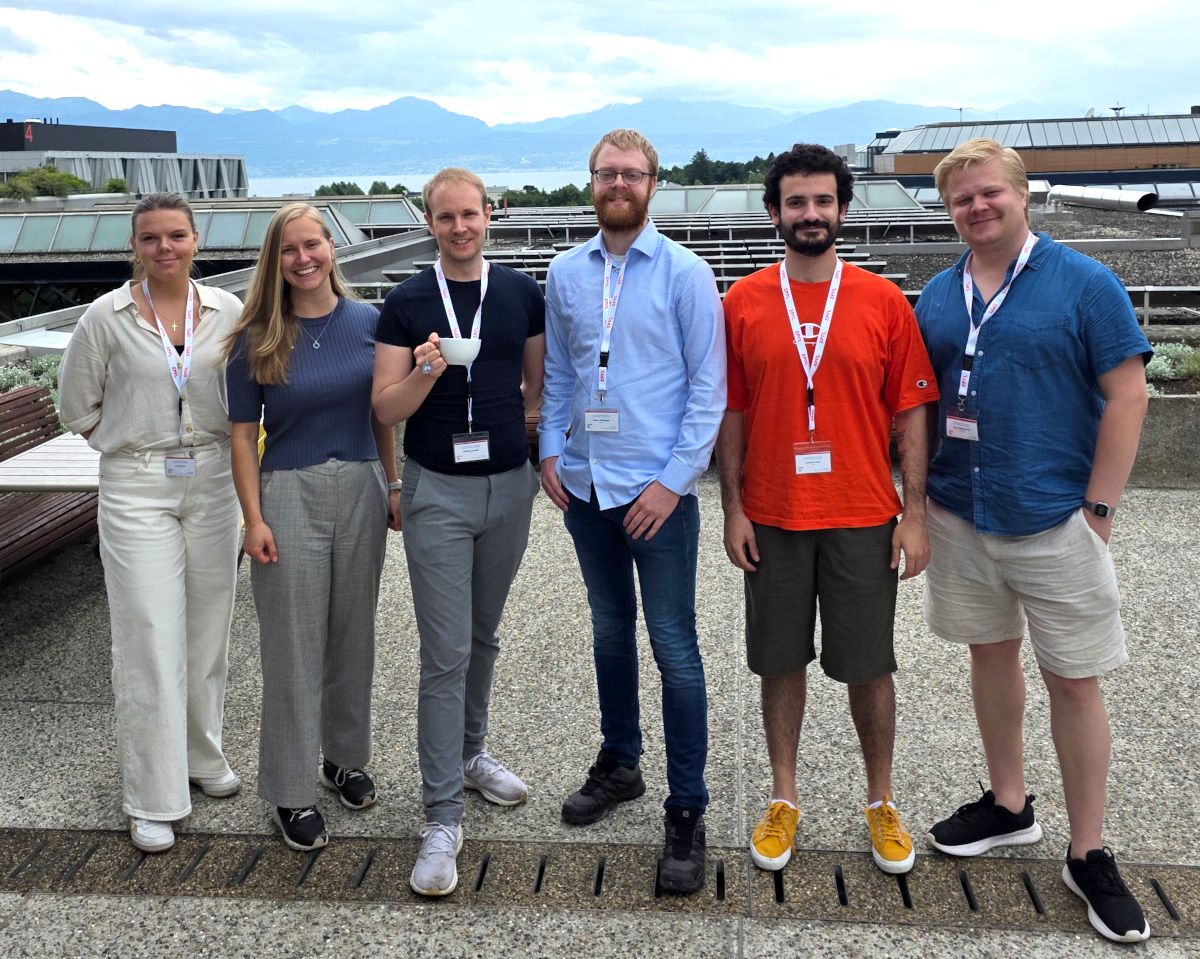 The DREAM Developer Council in 2025. From left: Linn Ekman, Ida Ekmark, Mathias Hoppe, Oskar Vallhagen, Lorenzo Votta, Peter Halldestam.
- Mathias Hoppe, KTH Royal Institute of Technology, Stockholm, Sweden
- Ida Ekmark, Chalmers University of Technology, Gothenburg, Sweden
- Lorenzo Votta, KTH Royal Institute of Technology, Stockholm, Sweden
- Linn Ekman, KTH Royal Institute of Technology, Stockholm, Sweden
- Oskar Vallhagen, Chalmers University of Technology, Gothenburg, Sweden
- Peter Halldestam, Max Planck Institute for Plasma Physics, Garching-bei-München, Germany
The code was originally developed within the Plasma Theory group at Chalmers but is now coordinated from KTH Royal Institute of Technology, still in close collaboration with Chalmers. Over the lifetime of the code, a large number of people from across the world have contributed to its development. A regularly updated list of contributors can be found in CONTRIBUTORS.md.
The archive of DREAM newsletters, where changes to DREAM are recorded, can be found at https://ft.nephy.chalmers.se/dreamnews/.
The original idea for DREAM was proposed by Ola Embreus who, together with Mathias Hoppe, developed the first version.