Owned vs Unowned
Owned values are data that a variable directly owns, meaning the variable is solely responsible for managing that data's memory.
Unowned values, in this context, refer to references (borrowed data) that provide temporary access to owned data without transferring ownership.
Readmore
static lifetime bound in function parameters
It means the type does not contain any non-static references. Eg. the receiver can hold on to the type for as long as they want and it will never become invalid until they drop it. (they and receiver means to function)
It's important to understand this means that any owned data always passes a 'static lifetime bound, but a reference to that owned data generally does not. Readmore
use std::fmt::Debug;

fn print_it( input: impl Debug + 'static ) {
    println!( "'static value passed in is: {:?}", input );
}

fn main() {
    // i is owned and contains no references, thus it's 'static:
    let i = 5;
    print_it(i);

    // oops, &i only has the lifetime defined by the scope of
    // main(), so it's not 'static:
    print_it(&i);
}
The compiler will tell you:
error[E0597]: `i` does not live long enough
  --> src/lib.rs:15:15
   |
15 |     print_it(&i);
   |     ---------^^--
   |     |         |
   |     |         borrowed value does not live long enough
   |     argument requires that `i` is borrowed for `'static`
16 | }
   | - `i` dropped here while still borrowed
static lifetime bound on return type on closure
what is impl Fn(crate::surface::Action) -> Message + 'static
pub fn applet_tooltip<'a, Message: 'static>(
        &self,
        content: impl Into<Element<'a, Message>>,
        tooltip: impl Into<Cow<'static, str>>,
        has_popup: bool,
        on_surface_action: impl Fn(crate::surface::Action) -> Message + 'static,
        parent_id: Option<window::Id>,
    )
+ 'static: The static lifetime bound on return type. It means the closure must not borrow any data from the local function's scope. All captured data must either be owned by the closure itself or have a 'static lifetime (meaning it lives for the entire duration of the program). This is a strong constraint that ensures the closure can be safely stored and used later without causing dangling pointers.
Box<T> allow you to store data on the heap rather than the stack.
What remains on the stack is the pointer to the heap.
The Box<T> is a smart pointer because it implements the Deref trait, which allows Box<T> values (T value) to be treated like refrences.
When Box<T> value goes out of scope, the heap data that the box pointing to is cleaned up because of the Drop trait implementation.
You can enable multiple ownership by using Rc<T>.
The Rc<T> type keeps track of number of references to a value to determine whether or not the value still in use.
Invoking clone on Rc produces a new pointer to the same allocation in the heap.
If there zero reference to a value, the value can be cleaned up.
Via the immutable refrences, Rc<T> allows you to share data between multiple parts of your program for reading only.
If Rc<T> allowed you to have multiple mutable reference too, you might violate one of the borrowing rules, multiple mutable borrows to the same place can cause
data races.
With RefCell<T>, borrowing rules are enforced at runtime.
Rc<T>, RefCell<T> is only for use in single-threaded.
The reasons to choose Box, Rc, or RefCell:
- Rc enables multiple owners of the same data; Box and RefCell have single owners.
- Box allows immutable or mutable borrows checked at compile time; Rc allows only immutable borrows checked at compile time; RefCell allows immutable or mutable borrows checked at runtime.
- Because RefCell allows mutable borrows checked at runtime, you can mutate the value inside the RefCell even when the RefCell is immutable.
With RefCell<T>, we use the borrow and borrow_mut methods, which are part of the safe API that belongs to RefCell<T>. The borrow method returns the smart pointer type Ref<T>, and borrow_mut returns the smart pointer type RefMut<T>. Both types implement Deref, so we can treat them like regular references.
The RefCell<T> keeps track of how many Ref<T> and RefMut<T> smart pointers are currently active. Every time we call borrow, the RefCell<T> increases its count of how many immutable borrows are active. When a Ref<T> value goes out of scope, the count of immutable borrows goes down by 1. Just like the compile-time borrowing rules, RefCell<T> lets us have many immutable borrows or one mutable borrow at any point in time.
The Rust standard library uses a 1:1 model of thread implementation, whereby a program uses one operating system thread per one language thread.
When the main thread of a Rust program completes, all spawned threads are shut down, whether or not they have finished running.
Create a new thread with thread::spawn
Rust will force the move keyword with closures passed to thread::spawn because the closure will then take ownership of the values it uses from the environment, thus transferring ownership of those values from one thread to another. see code
A channel is a general programming concept by which data is sent from one thread to another.
Imagine a channel being like a directional channel of water, such as a stream or a river. If you put something like a rubber duck into a river, it will travel downstream to the end of the waterway.
A channel has two halves: a transmitter and a receiver. The transmitter half is the upstream location where you put the rubber duck into the river, and the receiver half is where the rubber duck ends up downstream.
A chennel is said to be closed if either the *transmitter or receiver half is dropped.
Basic transmitter and receiver
Mutex is an abbreviation for mutual exclusion, as in a mutex allows only one thread to access some data at any given time.
Mutexes have two rules:
-
You must attempt to acquire the lock before using the data.
-
When you’re done with the data that the mutex guards, you must unlock the data so other threads can acquire the lock.
Arc<T> is like Rc<T> that for use in multiple threads.
Similarities Between RefCell/Rc and Mutex/Arc
RefCell allow us to mutate contents inside an Rc, we use Mutex to mutate contents inside an Arc.
The Sync trait indicates that it is safe to be referenced from multiple threads.
The Send trait indicates that ownership can be transfered between threads.
Almost all primitive types are Send.
All primitive types implement Sync.
Any types composed (the collection that containes item that implement Send) entirely of Send is automatically marked as Send.
Any types composed (the collection that containes item that implement Sync) entirely of Sync is also implement Sync.
Manullay implementing these traits is unsafe
asynchronous programming is where operations may not finish sequentially in the order they were started.
Illustrate of concurrency, you have two different projects checked out on your computer, and when you get bored or stuck on one project, you switch to the other. You're just one person, so you can't make progress on both tasks at the exact same time, but you can multi-task, making progress on one at a time by switching between them.
        |___________________________________________|
Man --> | --> A1 -   --> A2   --> A3 --> A4         | Task A
        |         \ /      \ /            \         |
        |         B1       B2             B3 --> B4 | Task B
        |___________________________________________|
feature is a value that may not be ready now but will become ready at some point in future, In Rust feature are type that implement the Feature trait, Each future hold its own information about the progress that has been made and what "ready" means.
The futures crate is an official home for Rust experimentation for async code, and it’s actually where the Future trait was originally designed.
futures in Rust are lazy: they don’t do anything until you ask them to with the await keyword.
Note: This is different from the behavior we saw in the thread::spawn, where the closure we passed to another thread started running immediately.
When Rust sees a block marked with the async keyword, it compiles it into a unique, anonymous data type that implements the Future trait. When Rust sees a function marked with async, it compiles it into a non-async function whose body is an async block. An async function’s return type is the type of the anonymous data type the compiler creates for that async block.
Thus, writing async fn is equivalent to writing a function that returns a future of the return type. To the compiler, a function definition such as the async fn page_title is equivalent to a non-async function defined like this:
use std::future::Future;
use trpl::Html;

fn page_title(url: &str) -> impl Future<Output = Option<String>> {
    async move {
        let text = trpl::get(url).await.text().await;
        Html::parse(&text)
            .select_first("title")
            .map(|title| title.inner_html())
    }
}
Let’s walk through each part of the transformed version:
-
It uses the
impl Traitsyntax. -
The returned trait is a
Futurewith an associated type ofOutput. Notice that the Output type isOption<String>, which is the same as the original return type from the async fn version ofpage_title. -
All of the code called in the body of the original function is wrapped in an
async moveblock. Remember that blocks are expressions. This whole block is the expression returned from the function. -
This async block produces a value with the type
Option<String>, as just described. That value matches theOutputtype in the return type. This is just like other blocks you have seen. -
The new function body is an
async moveblock because of how it uses theurlparameter.
The only place we can use the await keyword is in async functions or blocks, and Rust won’t let us mark the special main function as async.
Note: The reason main can’t be marked async is that async code needs a runtime: a Rust crate that manages the details of executing asynchronous code. A program’s main function can initialize a runtime, but it’s not a runtime itself.
Each await point—that (every place where the code uses the await keyword—represents) is a place where control is handed back to the runtime (Rust will pauses async blocks and hands control back to a runtime) Everything between await points is synchronous. That means if you do a bunch of work in an async block without an await point, that Future will block any other Futures from making progress.
- Waiting for an Asynchronous operation to complete: This is the most common use case. Any function that returns a
Futureneeds to be awaited to get its result.
// Awaiting a web request to finish
let resp = reqwest::get("https://example.com").await?;
let body = response.text().await?;

// Awaiting a file read operation
let contents = tokio::fs::read_to_string("my_file.txt").await?;- Waiting for a Channel to receive a message: Receiving a message is an asynchronous operation. You must
.awaitthe receive call to wait for a message to be sent.
// Awaiting the next message from a channel
let message = rx.recv().await?;- Waiting for a Stream to produce an item: Iterating over a
Streamrequires.await. The stream may not have an item ready immediately, so thenext()method returns aFuturethat you must await.
// Awaiting the next item from an async stream
while let Some(item) = stream.next().await {
    // ... process item
}- Waiting for a Time or a Delay: When you need to pause execution fro a specific duration without blocking the entrie thread, you use an asynchronous sleep function and
.awaitit.
// Awaiting an asynchronous sleep
tokio::time::sleep(Duration::from_secs(1)).await
Summary Think of .await as a signal to the async runtime: "I can't continue until this operation is done." Please pause me and go work on other tasks in the meantime.
Let's look more on how they are used
Feturerace to indicate which one will finish first- Create a new async task with
tokio::task::spawn - Join two
Futuresto make a concurrency work
When you want to hands control back to a runtime immediately, for avoid blocking for too long processing. example code
Stream is like Iterator but for asynchronous.
async channel receiver also stream, The first difference is time: iterators are synchronous, while the channel receiver is asynchronous The second is the API. When working directly with Iterator, we call its synchronous next method. With the trpl::Receiver stream in particular, we called an asynchronous recv method instead. Otherwise, these APIs feel very similar.
example of async channel receiver
building a little stream of messages
use std::pin::Pin;
use std::task::{Context, Poll};

pub trait Future {
    type Output;

    fn poll(self: Pin<&mut Self>, cx: &mut Context<'_>) -> Poll<Self::Output>;
}
Output is what the future resolves to.
Future has poll method, which take a:
Pinreference for itsselfparam- a mutable reference to a
Contexttype - method returns type is
Poll
enum Poll<T> {
    Ready(T),
    Pending,
}
Pending variant indicates that the future still has work to do, so the caller will need to check again later.
Ready variant indicates that the future has finished its work and the T value is available.
When you see code that uses await, under the hood its calls poll, look back at fn page_title, Rust compiles it into something like this:
let mut page_title_fut = page_title(url);
loop {
    match page_title_fut.poll() {
        Ready(page_title) => match page_title {
            Some(title) => println!("The title for {url} was {title}"),
            None => println!("{url} had no title"),
        }
        Pending => {
            // continue
        }
    }
}
Loop is for when the future is still Pending. We need some way to try again, until the future is finally ready.
Inside the Pending arm. Rust makes sure that the loop can hand off control to something that can pause work on this future, to work on other futures, and then check this one again later. That something is an async runtime, and this scheduling and coordination work is one of its main jobs.
Look back at example code on rx.recv. The recv call returns a future, and awaiting the future polls it. We noted that a runtime will pause the future until it's ready with either Some(message) or None when the channel closes. The runtime knows the future isn't ready when it returns Poll::Pending. Conversely, the runtime knows the future is ready and advances it when poll return Poll::Ready(Some(message)) or Poll::Ready(None)
Pin is a wrapper for pointer-like types such as &, &mut, Box, Rc (Technically, Pin works with type that implement the Deref or DerefMut trait, this is effectvely equivalet to working only with pointers.)
How it's work
a series of await points in a future get compiled into a state machine. To make that work, Rust looks at what data is needed between one await point and either the next await point or the end of the async block. Then creates a corresponding variant in the compiled state machine. Each variant gets the asscess it needs to the data that will be used in that section of source code, whether by taking ownership or by a mutable or immutable reference to it.
enum PageTitleFuture<'a> {
    Initial { url: &'a str },
    GetAwaitPoint { url: &'a str },
    TextAwaitPoint { response: trpl::Response },
}
When we move a future into a collection for use with join_all or by return it from a function that actually means moveing the state machine. Because the futures that Rust creates for async block can end up with references to themselves in the fields of any given variant.
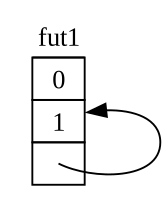
Any object that has a reference to itself is unsafe to move, because references always point to the actual memory address of whatever they refer to. If you move, those internal references will be elft pointing to the old localtion.
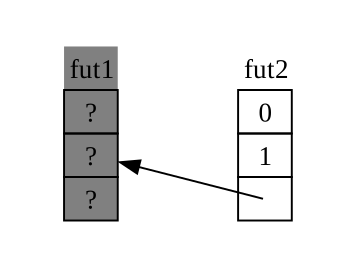
When we pin a value by wrapping a pointer to that value in Pin, it can no longer move.
If you have Pin<Box<SomeType>>, you actually pin the SomeType, not the Box pointer.
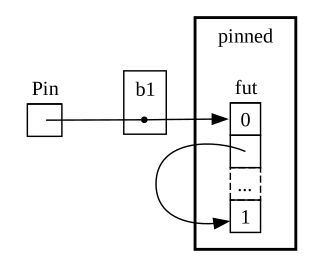
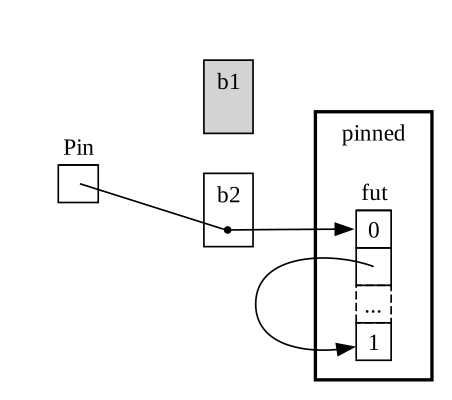
The Box can still move around freely. If a pointer move around, but the data it points to is in the same place there's no problem.
สรุปอีกครั้งเป็นภาษาไทย
ส่วนนี้จะอธิบายว่า trait Pin และ Unpin ถูกนำมาใช้ในภาษา Rust อย่างไร โดยเฉพาะอย่างยิ่งในบริบทของการเขียนโปรแกรมแบบอะซิงโครนัส (asynchronous) และtrait Future บทความนี้อธิบายว่า Future จำเป็นต้องใช้ตัวชี้แบบ Pin-wrapped (ตัวชี้ที่ถูกห่อหุ้มด้วย Pin) เพื่อให้สามารถถูก "poll" ได้ Pin ถูกอธิบายว่าเป็น wrapper (ตัวห่อหุ้ม) สำหรับชนิดข้อมูลที่คล้ายกับตัวชี้ ซึ่งบังคับใช้ข้อจำกัดในการใช้งานตัวชี้ แต่ตัวมันเองไม่ใช่ตัวชี้
บทความยังอธิบายว่า await จะทำการ pin future โดยอัตโนมัติ (implicitly pins) แต่เมื่อมีการย้าย futures ไปยัง collection เช่น Vec เพื่อส่งไปยังฟังก์ชันอย่าง join_all นั้น futures จะต้องถูก pin อย่างชัดเจน (explicitly pinned) เหตุผลก็คือบล็อก async สามารถสร้างชนิดข้อมูลที่มีการอ้างอิงถึงตัวเองได้ (self-referential types) และการย้ายพวกมันอาจไม่ปลอดภัย Unpin ถูกแนะนำให้เป็นเทรตชนิด marker (เครื่องหมาย) ที่บอกคอมไพเลอร์ว่าชนิดข้อมูลนั้นปลอดภัยที่จะย้ายได้ ชนิดข้อมูลส่วนใหญ่ใน Rust จะใช้ Unpin โดยอัตโนมัติ แต่ futures ที่มีการอ้างอิงถึงตัวเองจะไม่ได้ใช้ ส่วนสุดท้ายของบทความสรุปว่า Pin และ Unpin มีความสำคัญส่วนใหญ่สำหรับการสร้างไลบรารีหรือรันไทม์ระดับล่าง และการทำความเข้าใจเทรตเหล่านี้จะช่วยในการแก้ไขข้อความแสดงข้อผิดพลาดที่เกี่ยวข้องกับการ pinning ได้
โครงสร้างข้อมูลแบบ Self-Referential และเหตุผลที่ไม่ควรย้ายมัน
ข้อมูลแบบ self-referential (การอ้างอิงถึงตัวเอง) คือโครงสร้างข้อมูลที่เก็บตัวชี้ (pointer) หรือการอ้างอิง (reference) ไปยังตัวมันเองหรือไปยังส่วนอื่น ๆ ภายในตัวมัน ตัวอย่างที่ง่ายที่สุดคือโหนดของลิงก์ลิสต์ (linked list) ที่มีตัวชี้ไปยังโหนดถัดไป ซึ่งอาจมีตัวชี้ย้อนกลับไปที่โหนดก่อนหน้าได้ด้วย ตัวอย่างที่เกี่ยวข้องในบริบทของ async ในภาษา Rust คือ Future ที่ต้องจัดเก็บอ็อบเจกต์ชั่วคราวซึ่งถือการอ้างอิงไปยังข้อมูลภายในตัว Future นั้นเอง
ทำไมการย้ายถึงไม่ปลอดภัย
การย้ายโครงสร้างข้อมูลที่มีการอ้างอิงถึงตัวเองในหน่วยความจำสามารถนำไปสู่ปัญหา dangling pointers (ตัวชี้ที่ชี้ไปยังตำแหน่งหน่วยความจำที่ถูกปลดไปแล้ว) หรือ invalid references (การอ้างอิงที่ไม่ถูกต้อง) ซึ่งถือเป็นเรื่องไม่ปลอดภัยและอาจทำให้เกิดพฤติกรรมที่ไม่คาดคิดได้ เมื่อตัวแปรถูกย้าย ข้อมูลของมันจะถูกคัดลอกไปยังตำแหน่งใหม่ในหน่วยความจำ และหน่วยความจำเดิมจะถูกปลดปล่อย ปัญหาหลักของข้อมูลแบบ self-referential คือตัวชี้ภายในโครงสร้างยังคงชี้ไปยังตำแหน่งหน่วยความจำ เดิม ไม่ใช่ตำแหน่งใหม่
ลองนึกถึงภาพจำลองนี้:
สมมติว่าคุณมีแผนที่บ้านที่แต่ละห้องเป็นกระดาษหนึ่งแผ่น และคุณมีโน้ตในแผ่นกระดาษห้องนั่งเล่นที่เขียนว่า "ห้องครัวอยู่ห่างออกไป 3 เมตรทางขวาของฉัน" โน้ตนี้คือการอ้างอิงถึงตัวเอง เพราะมันอธิบายตำแหน่งโดยอ้างอิงจากตัวห้องนั่งเล่นเอง
ถ้าคุณย้ายกระดาษแผ่นห้องนั่งเล่นไปยังตำแหน่งใหม่ โน้ตนั้นก็ยังคงเขียนว่า "3 เมตรทางขวาของฉัน" แต่ตอนนี้การอ้างอิงนั้นไม่ถูกต้องแล้ว เพราะกระดาษแผ่นห้องครัวยังคงอยู่ที่ตำแหน่งเดิม การอ้างอิงนั้นจึงกลายเป็นไม่ถูกต้อง
ในทำนองเดียวกัน เมื่อโครงสร้างข้อมูลแบบ self-referential ถูกย้าย ตัวชี้ภายในของมันจะกลายเป็นไม่ถูกต้อง เพราะพวกมันยังคงชี้ไปยังที่อยู่หน่วยความจำเก่าซึ่งไม่ถูกต้องอีกต่อไป นี่คือเหตุผลที่คอมไพเลอร์ของ Rust ป้องกันไม่ให้ Future ที่มีการอ้างอิงถึงตัวเองถูกย้าย เว้นแต่จะถูก pin ซึ่งเป็นกระบวนการที่รับประกันว่าที่อยู่หน่วยความจำของมันจะไม่เปลี่ยนแปลง
Chapter summary
A task is similar to a thread, but instead of being managed by the operating system, it’s managed by library-level code: the runtime.
Threads act as a boundary for sets of synchronous operations; concurrency is possible between threads.
Tasks act as a boundary of sets of asynchronous operations; concurrency is possible both between and within tasks.